
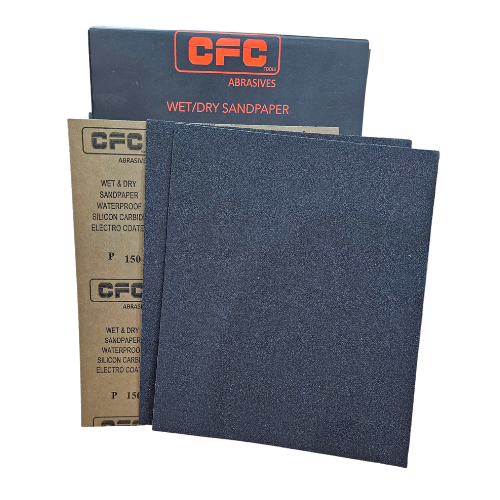
Sandpaper sheets shape, smooth, and finish metal and wood surfaces. An abrasive applied to backing material cuts small amounts of material from the workpiece to smooth the surface, remove sharp edges, and debur metal. Sheets are often torn down to fit handheld power sanders or to wrap around sanding blocks.
Wet/dry sandpaper for use on all surfaces have an open-coat silicon carbide abrasive applied to a paper backing. Paper-backed wet/dry abrasives are flexible and can be used dry or with water or another lubricant to prevent loading and minimize dust.
Type of Grit.
Lower grits (40 to 100) are used for rough sanding, while higher grit numbers (120 to 220) are used to prep for finishing. For most woodworking projects, we recommend using a progression of grits from 80 grit for rough sanding and ending at 220 grit for finishing prep.
40 - 80 Grit
Very coarse grit, and is good for removing a lot of material quickly. Often used for sanding rough surfaces, such as unfinished wood or a surface with heavy paint or rust.
100 - 120 Grit
Medium grit, and is good for smoothing out rough surfaces and removing scratches left by the coarse grit. Often used for sanding wood in preparation for staining or painting.
150 - 220 Grit
Fine grit, and is good for smoothing out surfaces and preparing them for a final finish. Often used for sanding wood between coats of paint or stain, or for preparing a surface for a clear coat.
320 - 1000 Grit
Very fine grits, and are good for achieving a smooth, polished finish. Often used for sanding between coats of paint or clear coat, or for finishing a surface to a high shine.
*XXXX denote grit type. Please indicate grit when ordering.